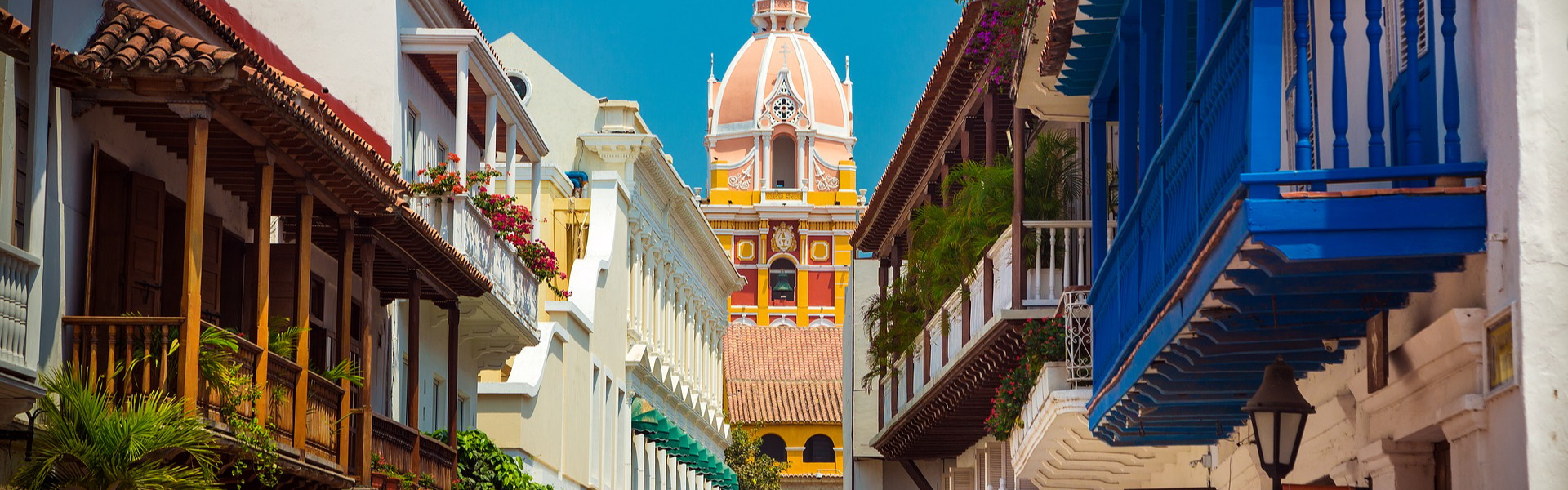
Cartagena is a sixteenth-century walled city on the Caribbean coast of Colombia. Eleven kilometres of ramparts, the largest fortress the Spanish ever built in the Americas, and inside a grid of narrow streets, wooden balconies and bougainvillea. It is a city destination before it is a beach destination, and that distinction changes everything when you book.
The essentials in four lines
- About eight hours from Montreal with a connection, usually via Bogotá or Panama, to Rafael Núñez airport (CTG), fifteen minutes from the centre.
- Colombia is on the same time as Montreal in winter and one hour behind in summer.
- The city lies south of the hurricane belt: there is no cyclone season.
- The urban beaches are brown and the water cloudy. The fine beaches are on the islands, an hour away by boat.
The walled city
The ramparts were built between 1586 and 1796, after the sack of the city by the privateer Francis Drake. They enclose a historic centre listed as UNESCO World Heritage since 1984, which is covered entirely on foot in a day.
Inside: the clock tower and its gateway, Plaza Bolívar and the former Inquisition palace, the sixteenth-century cathedral, the Santa Clara convent and dozens of colonial houses with shaded courtyards. In the evening you walk on the ramparts themselves, on the seaward side, as far as the café set in an old powder magazine.
San Felipe de Barajas fortress, on a hill outside the walls, was begun in 1536 and extended over two centuries. Its network of underground tunnels, designed so that the slightest sound carried to the defenders, is partly open to visitors.
Getsemaní
Just outside the walls, this working-class quarter was long avoided by visitors. It is now the liveliest part of the city: lanes covered in murals and hanging umbrellas, Plaza de la Trinidad where residents bring out their chairs at dusk, restaurants and small hotels in renovated houses.
This is where the nightlife happens, more than in Bocagrande, and prices stay well below those of the walled city.
Where the beaches are
It needs saying plainly: the beach at Bocagrande, below the towers of the modern district, is brown sand and the water carries sediment brought down by the Magdalena river. You walk there; you do not spend the week.
The real beaches are on the islands. The Rosario archipelago, forty-five minutes by speedboat, is a marine national park: twenty-seven islets, white sand, clear water and reefs. Playa Blanca, on Barú island, offers the same sand an hour and a quarter by boat or an hour by road since 2018, when the bridge was completed.
These excursions are done as day trips or with a night on site. Go early: after eleven, the group boats arrive in numbers.
Around
The Totumo mud volcano, an hour north, is a twenty-metre cone filled with body-temperature grey mud in which you float without being able to sink. You rinse off afterwards in the neighbouring lagoon. It is strange, much photographed and honestly good fun.
San Basilio de Palenque, an hour southeast, was founded in the seventeenth century by escaped slaves and recognised as free territory: the first emancipated community in the Americas. Its creole language, its music and its funeral rites are on the UNESCO list of intangible cultural heritage. The women in bright dresses selling fruit in the walled city come from there.
Accommodation
Three options depending on what you want. The converted colonial houses of the walled city, expensive but at the centre of everything. The small hotels of Getsemaní, more affordable and livelier. The towers of Bocagrande, with sea views and pools, fifteen minutes from the centre.
All-inclusive is rare in Cartagena itself: you find it mainly on the islands and at Barú. Since the city has hundreds of restaurants, room-only is the obvious choice for an urban stay. Our criteria for choosing an all-inclusive hotel help compare if you combine city and beach.
When to go
It is hot and humid all year, around 31 °C by day. From December to April the trade winds blow, humidity drops and rain is rare: the best period and the high season.
From August to November, late-day showers become frequent and the humidity is heavy, but rates fall markedly. Our guide on when to travel south from Montreal sets out the pricing calendar.
To plan this trip, see also our Colombie page, San Andres and our month-by-month calendar.


