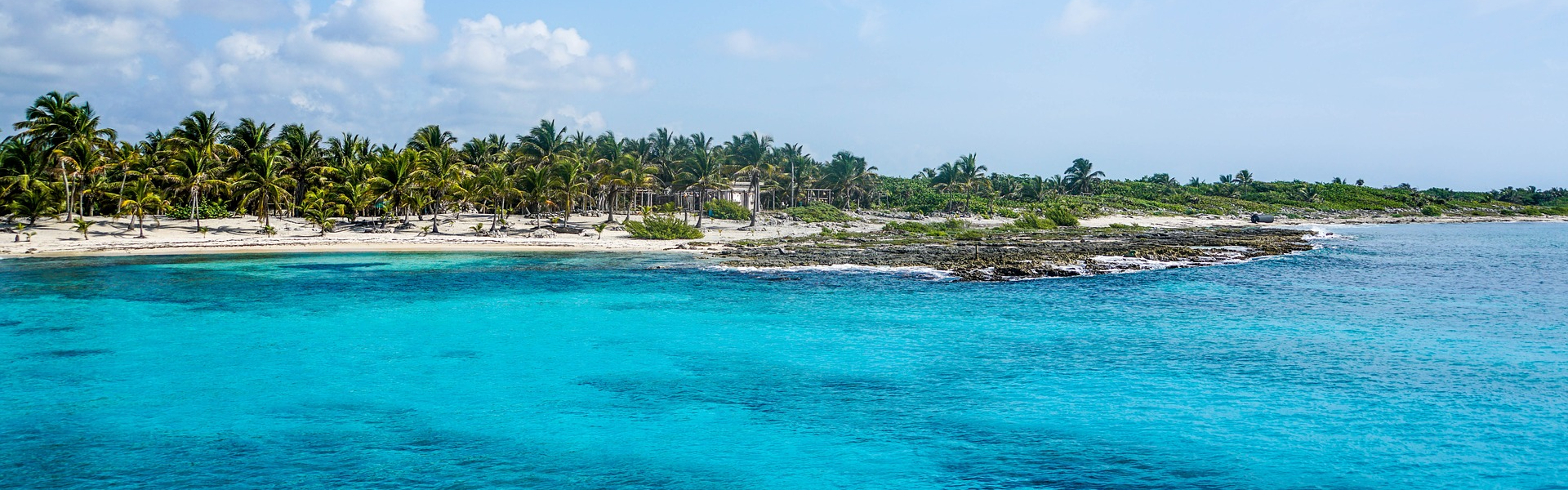
Cozumel is the largest inhabited island in Mexico: forty-eight kilometres long, sixteen wide, sitting nineteen kilometres off the Quintana Roo coast. One town, San Miguel, a road that circles it, and underwater a run of reefs that Jacques-Yves Cousteau brought to the world’s attention in a 1961 documentary. Sixty years on, that is still the first reason to come.
The essentials in four lines
- Ferry from Playa del Carmen in forty-five minutes, or a connecting flight into Cozumel airport (CZM).
- Quintana Roo stays on Eastern time all year: same hour as Montreal in winter, one hour behind in summer.
- The west coast is calm and sheltered; the east coast, open to the sea, is barely swimmable.
- December to April is the dry season. Sargassum mainly on the eastern side.
Diving, first
The Cozumel reefs national park protects the southwest of the island, where the Mesoamerican barrier forms coral massifs pierced by tunnels and chimneys. Palancar, Santa Rosa, Columbia and Punta Sur have appeared in world rankings for decades.
The local particularity is the current. You do not swim here: you are carried, the boat follows the bubbles and picks divers up at the end of the run. This drift diving is easy and restful once you understand the principle, but it calls for a serious operator and for following instructions.
For snorkelling, Chankanaab park and the Dzul-Ha reef work straight from shore, without a boat. Visibility regularly exceeds thirty metres from November to May.
Two coasts, two worlds
The west coast
Facing the mainland, it is sheltered from swell. This is where the town, the cruise piers, the hotels, the beach clubs and all the dive sites are. The sea is flat, the water clear, and sargassum far less present than on the Atlantic side.
The east coast
Open to the sea, it takes the swell head-on. No hotels, no village, a few isolated restaurants and kilometres of wave-battered beach. Swimming is dangerous except in two or three natural pools sheltered by rock. You come here to drive, walk and look, not to swim.
Renting a car or scooter to circle the island in a day remains the best way to grasp that contrast. Count sixty kilometres and plan for fuel: stations are scarce outside town.
What remains of the Maya
Cozumel was a sanctuary dedicated to Ixchel, goddess of fertility and the moon. Maya women from across the peninsula made the journey here at least once in their lives, by canoe. The San Gervasio site, in the centre of the island, preserves the remains of that sanctuary: not monumental pyramids but low structures scattered through the forest, and one of the few sites in Mexico whose purpose is precisely known.
At the southern tip, the Punta Sur ecological park gathers a lighthouse, a lagoon populated by crocodiles, an empty beach and a small Maya temple that served as a navigation marker: wind funnelling through its openings produced a whistle audible from the sea.
The town and the cruise ships
San Miguel hosts one of the busiest cruise ports in Mexico, which changes the face of the town from day to day. When three or four ships are alongside, the waterfront and the jewellery shops are saturated until mid-afternoon. Walk three streets inland and you find the real town: the main square, the taquerías, the municipal market.
Check the call schedule before planning a dive or an outing in town. Tuesdays and Saturdays are often quieter.
All-inclusive in Cozumel
The offering is narrower than in Cancún or the Riviera Maya, with about a dozen resorts north and south of town on the sheltered coast. Several are built around diving and sell packages including daily boat dives.
The beaches at these hotels are often narrow and sometimes man-made, the coast being rocky in places: that is the first thing to check if you are coming primarily for the beach. If you are coming to dive, it matters far less. Our criteria for choosing an all-inclusive hotel cover the rest.
When to go
From December to April the air holds around 28 °C, humidity is low and the sea at its calmest. It is also the best diving visibility and the cruise high season.
From June to October, heat climbs, late-day showers become daily and the cyclone season peaks. May and November offer the best balance of conditions and price. Our guide on when to travel south from Montreal details those windows, and our file on sargassum sets out the picture across the peninsula.
To plan this trip, see also our Mexique page, Playa Mujeres, Puerto Vallarta and the sargassum picture.


