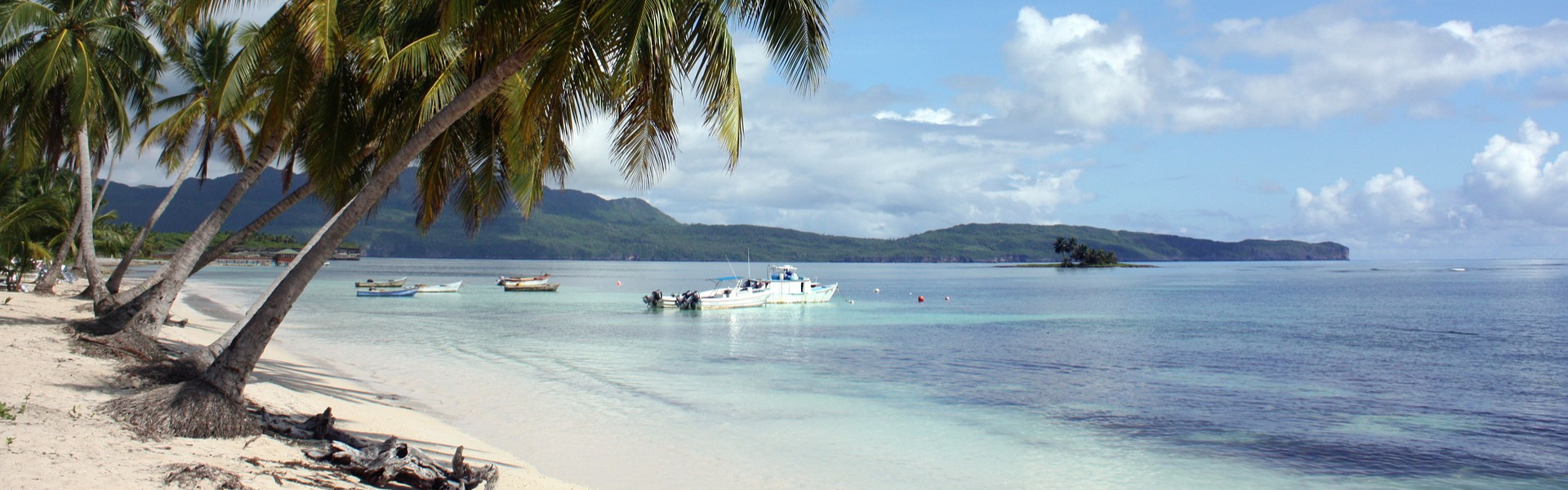
The Samaná peninsula pushes into the Atlantic in the northeast of the Dominican Republic, separated from the rest of the country by a deep bay and by hills covered in coconut palms. It is the greenest and most broken part of the Dominican coast, and the one where tourism has stayed most discreet: no continuous hotel zone, but three distinct villages, each with its own character.
The essentials in four lines
- About four hours on a seasonal non-stop from Montreal to El Catey airport (AZS), thirty to forty-five minutes from the villages.
- The Dominican Republic is one hour ahead of Montreal in winter and on the same time in summer.
- Humpback whales occupy the bay from mid-January to late March.
- December to April is the dry season. Hurricane season runs June to November.
The whales
This is the main reason to come between 15 January and 25 March. Several thousand humpback whales come down each winter from the North Atlantic to Samaná Bay to mate and calve: the water is shallow, warm and sheltered, which makes it one of the three or four best viewing sites on the planet.
Trips leave from the harbour at Santa Bárbara de Samaná, run three to four hours and operate under strict rules: a limited number of boats per zone, minimum distance, controlled approach time. Book ahead, especially in February.
The three villages
Las Terrenas
On the northern coast of the peninsula, the liveliest and most international village, with a strong French and Italian presence since the 1980s. Restaurants, bakeries, markets, and three beaches in a row: Las Ballenas, Bonita and Cosón, the last several kilometres long and practically deserted on a weekday.
Santa Bárbara de Samaná
The main town, on the bay, with its harbour, its market and a pedestrian bridge linking two islets. It is the departure point for excursions and the most practical base during whale season, but the town itself has few beaches.
Las Galeras
At the eastern end, a fishing village at the end of the road. It is the quietest sector, and the access point for Playa Rincón, a three-kilometre beach closed off by a green cliff and regularly named among the finest in the Caribbean. You reach it by track or by boat from the village.
Los Haitises
Across the bay, Los Haitises national park protects a tropical karst landscape: hundreds of forest-covered limestone knolls rising out of the mangrove. You cross it by boat, with stops in caves bearing Taíno pictographs centuries old.
The park also holds the country’s largest colony of frigatebirds and pelicans. The outing takes a full day from Samaná.
El Limón waterfall
A fifty-two-metre fall in the middle of the forest, reached in forty minutes on foot or on horseback from several trailheads. The path is muddy after rain and the pool at the foot is deep and cold. It is the peninsula’s classic excursion.
All-inclusive in Samaná
The supply is limited: a few large resorts around Las Terrenas and on the bay, plus a handful of mid-size hotels and independent addresses. The rest of the accommodation consists of villas and small hotels sold without meals.
It is the right choice for anyone who wants the Dominican Republic without the density of Punta Cana, accepting fewer services and more travelling. The peninsula’s roads are winding: distances take longer than the map suggests. Our criteria for choosing an all-inclusive hotel help compare.
When to go
From December to April the air holds around 28 °C and rain stays brief. The local high season matches the whale period, mid-January to late March, with higher rates and more visitors.
The peninsula is greener and slightly wetter than the east of the country. Sargassum mainly affects the northern coast of the peninsula; the bay side stays more sheltered. Our guide on when to travel south from Montreal sets out the pricing calendar, and our file on sargassum takes stock of the situation.
To plan this trip, see also our Republique Dominicaine page, Punta Cana, Santo Domingo and Mexico or the Dominican Republic.


