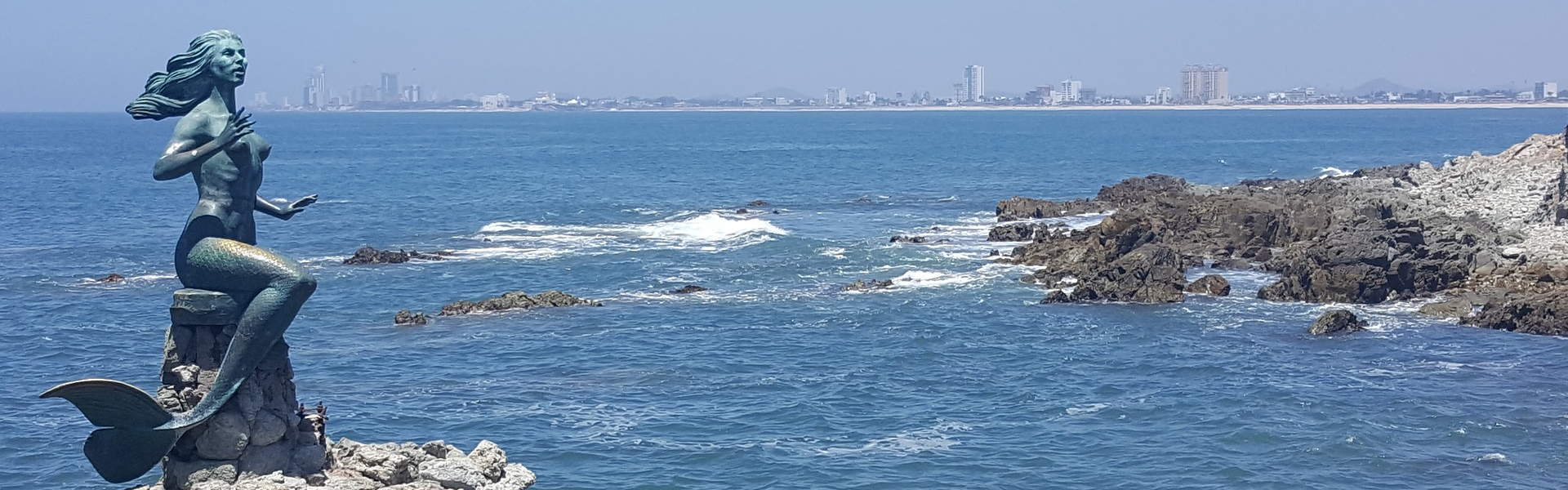
Mazatlán has a history most Mexican beach resorts lack: it was a prosperous port in the nineteenth century, with an Italianate theatre, courtyard houses and a merchant class, long before tourism existed. That old centre was restored from the 1990s onward, and it now gives the city a depth that purpose-built hotel zones do not have.
The essentials in four lines
- About six hours from Montreal, with seasonal non-stop service to Mazatlán (MZT), twenty-five minutes from the hotels.
- Sinaloa runs two hours behind Montreal in winter and three in summer.
- No sargassum. The water is cooler than the Caribbean in winter, around 22 degrees.
- November to May is the dry season. Rain and cyclones from June to October.
Three cities in one
The historic centre
Around Plazuela Machado, a hundred or so nineteenth-century buildings hold restaurants, galleries and terraces. The Ángela Peralta theatre, opened in 1874, abandoned for decades and then restored, programmes concerts and shows all year. It is the most interesting quarter in the city, and the most agreeable in the evening.
The Golden Zone
A few kilometres north, the classic hotel strip: Playa Gaviotas and Playa Camarón, hotels of every category, shops and visitor-facing restaurants. This is where most of the all-inclusive offering sits.
The north
Beyond, toward Cerritos and Nuevo Mazatlán, recent developments spread along wider and far quieter beaches, with a golf course. Calmer, but you need a car or taxi for everything.
The malecón
The seafront promenade links the historic centre to the Golden Zone over several kilometres, and ranks among the longest in the country. You cover it on foot, by bicycle or in a pulmonía, the small open vehicles that serve as local taxis and exist nowhere else.
Two stops are worth making along the way. Cliff divers launch from a ten-metre platform above a rock pool several times a day, timing the swell. And the lighthouse on Cerro del Crestón, perched a hundred and fifty-seven metres on a headland, is earned by a steep thirty-minute stair that ends on a glass walkway suspended over the drop.
The islands and the water
Three rocky islands close the horizon off the Golden Zone. Deer Island is reached by glass-bottom boat for a half-day of beach and snorkelling. Stone Island, ten minutes by ferry from the harbour, is not really an island: it is a long coconut-planted peninsula with a beach several kilometres long, grilled-fish palapas and almost nobody on a weekday.
From December to March, humpback and grey whales pass offshore; trips leave from the marina. The sea here stays cooler than the Caribbean in winter: count 21 to 23 degrees in January and February, close to 29 in September.
What you eat
Mazatlán is Mexico’s leading shrimp port, and it shows at the table. Aguachile, raw shrimp cured in lime juice with serrano chilli and cucumber, is the local speciality: sharp, raw, served cold, and like nothing else. Pescado zarandeado, butterflied and grilled over wood in a double rack, is shared between several people.
The city has also brewed the best-known beer of the Mexican Pacific since 1900, in a plant visible from the harbour.
Carnival
Mazatlán’s is among the oldest and largest on the continent, with more than a century of continuous history. It runs for a week in February and transforms the city entirely: floats, the crowning of a queen, a pyrotechnic naval battle above the bay, and hundreds of thousands of visitors. If you travel then, book very early; otherwise, avoid those dates.
All-inclusive in Mazatlán
The offering is real without being vast: a few large resorts in the Golden Zone and to the north, generally at lower rates than Cancún or Los Cabos at comparable category. It is one of the most affordable Mexican destinations from Quebec.
Since the city is lively and its restaurants numerous and inexpensive, the room-only option deserves comparison, especially if you stay near the historic centre. Our criteria for choosing an all-inclusive hotel and our file on affordable all-inclusive resorts from Quebec will help place the prices.
When to go
From November to May the sky stays clear, the air holds around 27 °C by day and the evenings are mild. December and January can be cool after dark: bring a light jacket.
From June to October, heat and humidity climb sharply, late-day storms become daily and the Pacific cyclone season peaks. Our guide on when to travel south from Montreal sets out the pricing windows.
To plan this trip, see also our Mexique page, Cozumel, Guadalajara and Punta Cana or Cancun.


