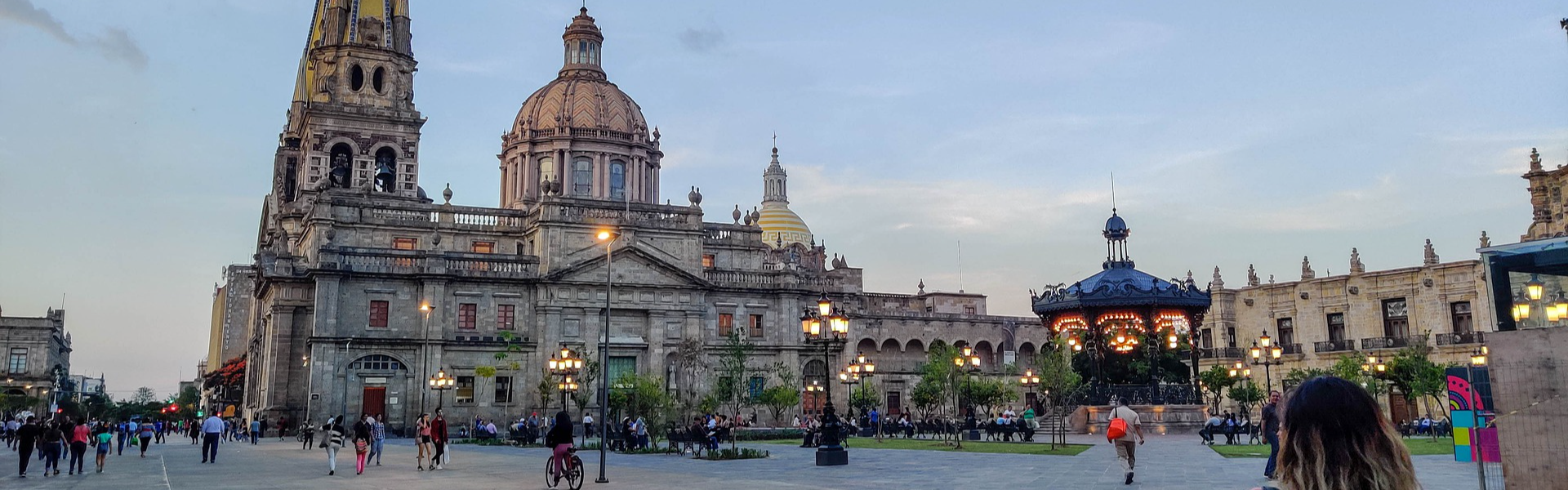
Guadalajara is not a beach destination, and that is worth saying up front: it is a highland city at fifteen hundred metres, five hours by road from the coast. It is also Mexico’s second city, the birthplace of mariachi and tequila, and the place where much of what is considered typically Mexican was invented.
The essentials in four lines
- About six hours from Montreal with a connection, to Guadalajara international airport (GDL).
- Jalisco runs one hour behind Montreal in winter and two in summer.
- Altitude tempers the climate: around 25 °C by day year-round, with cool nights in winter.
- November to May is the dry season. Rain from June to October, mostly late in the day.
The historic centre
Four squares surround the cathedral and its two yellow spires, forming a cross when seen from above. Around them, the Degollado theatre, the government palace and the city hall date from the nineteenth century or earlier.
The building not to miss is the Hospicio Cabañas, a former orphanage of 1810 inscribed on the UNESCO World Heritage list. Its dome holds a series of frescoes painted by José Clemente Orozco between 1936 and 1939, including a man in flames that ranks among the strongest images in twentieth-century Mexican art. You lie on benches provided for the purpose to look at it.
Nearby, the San Juan de Dios market is one of the largest covered markets in Latin America: three floors, thousands of stalls, and a food section where you eat the torta ahogada, the local sandwich drowned in spiced tomato sauce.
Mariachi
Mariachi music was born in this region and is listed as UNESCO intangible cultural heritage. The Plaza de los Mariachis downtown gathers ensembles available by the song, as they have been for generations. The more interesting gathering, though, is in Tlaquepaque, where groups play from an open bandstand among the restaurants.
Tlaquepaque and Tonalá
Two former villages absorbed by the city and now the capitals of Mexican craft. Tlaquepaque lines up pedestrian streets of galleries, ceramicists and glassblowers in colonial houses with shaded courtyards. Tonalá, more working-class, holds an open-air market twice a week where you buy straight from the workshops.
This is where the high-fired ceramics, blown glass, wrought iron and papier-mâché that supply the whole country are made.
Tequila
The village of Tequila is an hour away, in a landscape of blue agave fields itself inscribed on the World Heritage list. The plants ranked across volcanic hills produce a mineral, orderly landscape seen nowhere else.
The great houses open their distilleries: agave hearts baked in stone ovens, crushing, fermentation, double distillation, barrel ageing. A tourist train links Guadalajara to the village for the day, with tastings on board; the coach option is markedly cheaper and just as complete.
Lake Chapala
Mexico’s largest lake lies forty-five minutes south, at fifteen hundred metres. Its shores, particularly the villages of Ajijic and Chapala, have hosted since the 1950s one of the largest North American retiree communities in Latin America, drawn by an exceptionally stable climate. You go for the day: a walk along the water, galleries, the Wednesday market.
How to fit Guadalajara into a trip
Few Quebec travellers come for a full week. The formula that works best is to combine two or three nights in Guadalajara with a beach stay on the Pacific coast: Puerto Vallarta is four hours by road or forty-five minutes by air, and the Riviera Nayarit is right beside it.
Accommodation sells room-only, as in any large city: there is no all-inclusive here. If your trip combines the two, our criteria for choosing an all-inclusive hotel will apply to the beach portion.
When to go
Altitude softens everything: days sit around 25 to 28 °C nearly all year, and winter nights sometimes drop below 10 °C. From November to May the sky stays clear. From June to October, late-day storms are daily but brief, and the city turns green.
Two moments mark the calendar: the September independence festivities, and the Fiestas de Octubre, a month of concerts and fairs. Our guide on when to travel south from Montreal places those periods in the departure calendar.
To plan this trip, see also our Mexique page, Puerto Vallarta, Riviera Diamante and Punta Cana or Cancun.


