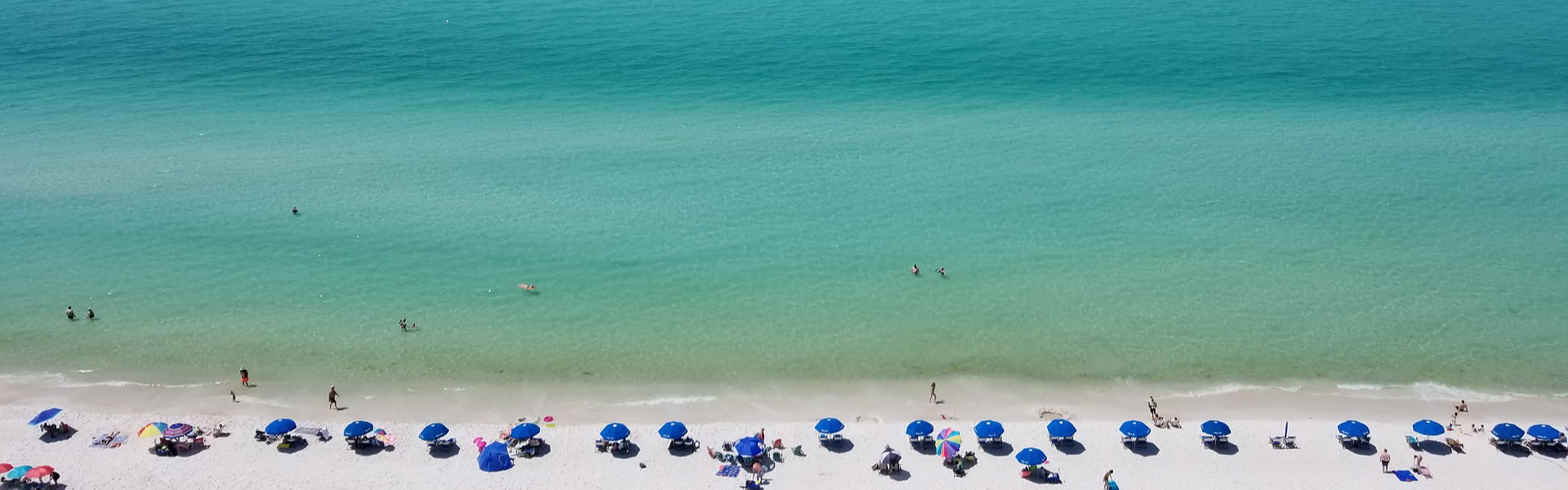
Playa Blanca lies on Panama’s Pacific coast, in Coclé province, an hour and fifteen minutes west of the capital by road. It is the country’s main beach area: a few large all-inclusive resorts lined along a broad golden-grey beach, with the cordillera and an inhabited volcanic crater three quarters of an hour inland.
The essentials in four lines
- About five and a half hours non-stop from Montreal to Panama (PTY), then an hour and fifteen to an hour and a half by road.
- Panama keeps Eastern time all year: same hour as Montreal in winter, one hour behind in summer.
- No sargassum: the coast faces the Pacific. The sand is golden grey, not white.
- The tidal range is large, up to four metres: the beach changes completely between high and low tide.
The beach, and what to know about it
It runs several kilometres, wide and straight, lined with coconut palms. Two things distinguish it from the Caribbean beaches it is sometimes wrongly compared with.
First the tide. The Panamanian Pacific has a range of three to four metres, against a few dozen centimetres in the Caribbean. At low tide the sea withdraws more than a hundred metres and reveals a vast expanse of firm sand, excellent for walking; at high tide it comes back to the palms. Check your hotel’s tide table: it changes the shape of the day.
Then the colour. Pacific water is greener and less clear than the Caribbean, because of cold currents and sediment. The sand is golden grey, of volcanic origin. It is beautiful in another way, but it is not the turquoise postcard.
Swimming is generally safe in front of the resorts, but rip currents form on a falling tide: respect the flags.
El Valle de Antón
This is the outing that alone justifies coming here. Forty-five minutes inland, a village of six thousand people occupies the floor of a six-kilometre-wide volcanic crater at six hundred metres. It is one of the few inhabited craters in the world.
The air is cool, the vegetation dense, and the Sunday morning market gathers orchids, crafts and mountain produce. Around it: hot springs, waterfalls, a ridge trail along a mountain whose profile suggests a sleeping woman, and a conservation centre for the golden frog, the national emblem now extremely rare.
The other outings
The Panama Canal and Casco Viejo are visited as day trips from the resorts, with an hour and fifteen minutes on the road each way.
From July to October, humpback whales from the southern hemisphere calve in the Gulf of Panama; trips leave from the coastal marinas. Iguana Island, further west on the Azuero peninsula, offers white sand and a reef on a day excursion.
Altos de Campana national park, the country’s oldest, sits on the road between the capital and the coast.
All-inclusive at Playa Blanca
Almost all of Panama’s all-inclusive supply is concentrated here: three or four large resorts, including one very large holiday village and two newer properties. Rates are among the most affordable in Central America at comparable category.
There is, however, no tourist village, no shopping street and no independent restaurant within walking distance: you stay at the resort or book excursions. Our criteria for choosing an all-inclusive hotel and our file on affordable all-inclusive resorts from Quebec help compare.
When to go
The dry season runs mid-December to mid-April: clear skies, steady trade winds, very little rain. That is the best period and the Quebec high season.
From May to November, showers fall in the late afternoon, the vegetation greens and prices drop. Panama lies outside the hurricane track, which clearly distinguishes it from Caribbean destinations at the same time of year. Our guide on when to travel south from Montreal sets out the pricing calendar.
To plan this trip, see also our Panama page, Gamboa, Panama City and resorts that suit families.


