Departure

Return


Loading

Dublin Travel from Canada: The Complete Guide

Dublin is one of the easiest European capitals to reach from Canada. Air Canada flies nonstop from Montreal (YUL) in about 6 hours, one of the shortest transatlantic crossings from the city, and four airlines fly nonstop from Toronto (YYZ) year-round: Air Canada, Aer Lingus, Air Transat and WestJet, in roughly 6.5 to 7 hours. Canadian citizens need no visa for stays of up to 90 days. Just as useful for trip planning: Ireland is in the European Union but outside the Schengen Area, so days spent in Ireland do not count toward the 90-days-in-180 Schengen limit. The best time to visit runs from May to September, with the sweet spot in May-June and September. As a guideline, budget $110 to $150 CAD per person per day at the low end and $260 to $340 CAD mid-range, excluding flights. The time difference with Montreal and Toronto is only 5 hours.

The essentials at a glance

Item What to know
Flight from Montreal/Toronto Nonstop from Montreal (Air Canada, about 6 h); nonstop from Toronto with 4 carriers year-round (6 h 25 to 7 h)
Visa/entry No visa for up to 90 days; outside Schengen (no EES, no ETIAS)
Time difference +5 hours (noon in Montreal or Toronto = 5 p.m. in Dublin)
Currency Euro (€); 1 € ≈ $1.62 CAD (July 2026)
Language English (Irish is also an official language)
Best time to go May to September; May-June and September to avoid peak crowds
Driving On the left
Electricity Type G plugs, 230 V (adapter required)

Why Dublin

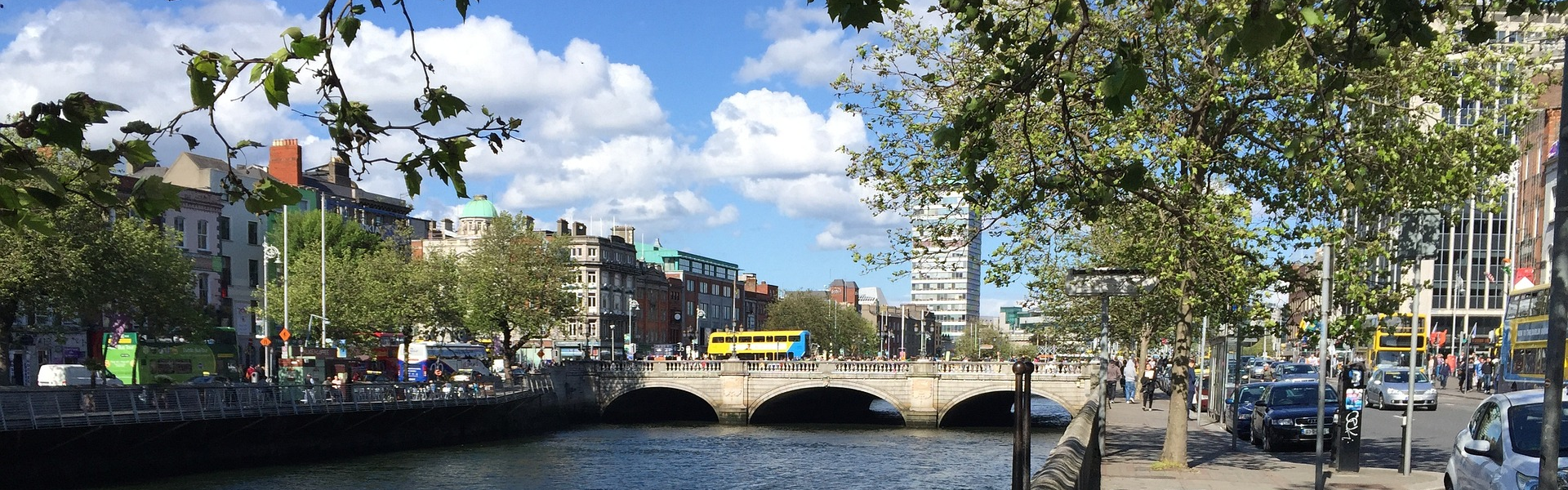
Dublin is a capital on a human scale: the centre is walkable, from the Trinity College campus to the quays of the Liffey, through the Georgian quarter and its colourful doors around St Stephen's Green and Merrion Square. The city delivers very concrete experiences: the Book of Kells, the Guinness Storehouse (the country's number one paid attraction), pubs where live music fills the evenings, and a bay you can reach by commuter train in under 30 minutes.

It is also a smart gateway to Europe. Because Ireland sits outside the Schengen Area, time spent in Dublin does not use up your 90-days-in-180 Schengen allowance. In practice, a traveller spending two weeks in France and Italy can add a week in Ireland without touching the Schengen clock. Keep your passport handy: it is required to travel between Ireland and the rest of Europe.

Finally, Dublin makes an excellent base. The DART coastal train reaches the seaside villages of Howth and Dún Laoghaire, Glendalough and the Wicklow Mountains are an hour away, the Neolithic site of Newgrange is 45 minutes from the city, and the Cliffs of Moher can be done as a full-day tour.

When to go

Period Climate Notes
May to June 15-20 °C, long days The best balance of weather and crowds
July to August 15-20 °C, longest days Festival season, but peak crowds and prices
September Mild, days still long The year's second-best window
October to April Mild winter (4-8 °C), short days Pub season; around March 17 (St. Patrick's Day), book far in advance

Ireland's ocean climate is mild all year, but rain is possible in any season: a rain jacket belongs in your suitcase even in July. From May to September, long daylight hours leave plenty of time to combine city sightseeing with a trip out along the bay.

Getting there from Canada

From Montreal, Air Canada flies nonstop to Dublin (flight AC916, Boeing 787-9) four times a week (Monday, Wednesday, Friday and Sunday), departing around 8:50 p.m. for a flight of about 6 hours eastbound, with extra frequencies in summer. You take off in the evening and land in the morning, ready to start the day. From Toronto, four carriers fly nonstop year-round, daily or nearly daily each: Air Canada, Aer Lingus, Air Transat and WestJet, with flight times of about 6 h 25 to 7 h. Air Transat also sells the Montreal-Dublin route; depending on your dates, your advisor will confirm whether it operates as a seasonal nonstop or with a connection. Connecting via London is another option.

Dublin's highlights

Trinity College and the Book of Kells

In the heart of the city, Ireland's oldest university houses the Book of Kells, an illuminated manuscript from the 9th century, and the famous Long Room of its old library. It is Dublin's most in-demand cultural visit: tickets are timed and sold online, and in high season you should book several days ahead. Afterwards, stroll the campus, then wander into the neighbouring Georgian quarter for the colourful doors of Merrion Square.

Temple Bar and the pub scene

Temple Bar is Dublin's most photographed district: cobbled lanes, red facades and pubs where you can generally hear live traditional Irish music in the evening. To be frank, it is also the most touristy part of the city, and prices there are inflated. The smart approach is to soak up the atmosphere, then widen your pub crawl to neighbourhood pubs, where pints cost less and the crowd is more local. The pub scene remains the capital's number one social experience, winter and summer alike.

Guinness Storehouse and the distilleries

The Guinness Storehouse is the most visited paid attraction in the country. The tour ends at the Gravity Bar, with a 360-degree view over the city, pint in hand. Dublin also keeps its whiskey tradition alive: several distilleries and visitor centres in the city generally offer guided tours with tastings, a fine way to compare Irish whiskey with its Scottish cousins. Book the Storehouse online to lock in your time slot.

Dublin Bay by DART: Howth and Dún Laoghaire

The DART, the electric coastal train, is the simplest half-day trip you can take. Northbound, Howth (about 25 minutes) combines a cliff path, a fishing harbour and seafood restaurants. Southbound, Dún Laoghaire and Dalkey offer piers, seafront walks and well-heeled villages. In town, the Luas tram (2 lines) rounds out the network, and the rechargeable Leap Card works across public transit: bus, tram and DART.

Day trips: Cliffs of Moher, Glendalough and beyond

The Cliffs of Moher, in County Clare, are about 265 km from Dublin: full-day coach tours are a well-oiled routine, but plan on a long 13-to-14-hour round trip. Closer in, Glendalough and the Wicklow Mountains, an hour from the capital, offer a monastic site in a glacial valley, and Newgrange, a UNESCO-listed Neolithic site, is 45 minutes away. Heading north, Belfast and the Giant's Causeway are in Northern Ireland: bring pounds sterling, as you leave the euro zone there.

The budget, in Canadian dollars

Category Per person, per day (as a guideline)
Budget $110 to $150 CAD: hostel, pub grub, walking plus a Leap Card
Mid-range $260 to $340 CAD: 3-star hotel, restaurants, attractions
Comfort $550 CAD and up: 4-5 star hotel in the centre, fine dining, private tours

These amounts are guidelines only, exclude flights, and vary with the season and the exchange rate (1 € ≈ $1.62 CAD in July 2026). Dublin is an expensive city, especially for accommodation: booking early makes a real difference, particularly in summer and around St. Patrick's Day. On the plus side, contactless card payment is accepted everywhere, which limits cash exchange fees.

Entry requirements and health for Canadian citizens

  • Passport: must be valid for the length of your planned stay. Ireland does not apply the Schengen three-extra-months rule, but a comfortable validity margin is still recommended.
  • Visa: none required for tourism or business for up to 90 days. The length of stay is granted by the immigration officer on arrival, who may ask for proof of a return ticket and sufficient funds.
  • Outside Schengen: neither the EES system nor the ETIAS authorization applies to Ireland, and your stay does not count toward the 90-days-in-180 Schengen limit.
  • Vaccines: routine vaccinations up to date; hepatitis B is recommended. No yellow fever requirement.
  • Travel insurance: strongly recommended, with medical evacuation coverage, even though health care in Ireland is excellent.
  • Official advice: check travel.gc.ca before departure. Ireland is rated “Take normal security precautions,” the lowest risk level; stay alert to pickpockets and theft from cars in Dublin.

One last tip: build your stay around simple blocks, two or three days in the city, a DART outing along the bay and one full-day excursion outside Dublin. That rhythm leaves your evenings free for the pubs without rushing your days.

Ready to cross the Atlantic in a 6-hour nonstop flight? An AquaTerra advisor will compare dates, carriers and excursions for you, and build an Irish itinerary that fits your pace. 450-628-6241 | 1-866-628-6241 | info@voyagesaquaterra.com

Voyages AquaTerra holds a Québec travel agency permit.

Frequently Asked Questions

No. Canadian citizens do not need a visa for tourist or business stays in Ireland of up to 90 days. The exact length of stay is granted by the immigration officer on arrival, who may ask for proof of a return ticket and sufficient funds. Neither EES nor ETIAS applies to Ireland.
From Montreal, Air Canada's nonstop takes about 6 hours, one of the shortest transatlantic flights from YUL, four times a week. From Toronto, four carriers fly nonstop year-round (Air Canada, Aer Lingus, Air Transat and WestJet), taking roughly 6 h 25 to 7 h.
May to September: long days, 15 to 20 °C and festival season. May-June and September offer the best balance of weather and crowds, while July-August is peak season for both visitors and prices. Rain is possible in any season, so pack a rain jacket.
Yes. The Government of Canada rates Ireland at “Take normal security precautions,” its lowest risk level. Petty crime targeting tourists does exist, mainly pickpocketing and theft from cars: normal vigilance is enough.
As a guideline, excluding flights: $110 to $150 CAD per person per day on a budget, $260 to $340 CAD mid-range, and $550 CAD and up for comfort. Accommodation is Dublin's biggest expense; booking early helps significantly.
Dublin is 5 hours ahead of Montreal and Toronto: noon in Eastern Canada is 5 p.m. in Dublin. It is one of the smallest time differences in Europe for Canadian travellers, which makes adjusting on arrival easier.
No. Ireland is a member of the European Union but sits outside the Schengen Area. A stay in Ireland therefore does not count toward the 90-days-in-180 Schengen limit, which makes it an excellent way to extend a European trip. A valid passport is required to travel between Ireland and the rest of Europe.
The city centre is walkable. For everything else, the rechargeable Leap Card covers public transit: buses, the Luas tram (2 lines) and the DART coastal train. The DART reaches Howth in about 25 minutes and serves Dún Laoghaire and Dalkey on the south side of the bay.
Yes. Tickets for the Book of Kells and Trinity College's Long Room are timed and sold online. In high season, book several days ahead to get the time slot you want. The illuminated manuscript dates from the 9th century.
Yes, it is the classic day trip: the cliffs are in County Clare, about 265 km away, and full-day coach tours are a well-oiled routine. Plan on a long 13-to-14-hour round trip, though. Closer options include Glendalough and the Wicklow Mountains, an hour from Dublin.
  • #Travel
  • #Tourism
  • #Dublin
  • #Ireland
  • #Visit
  • #Attractions
  • #Culture
  • #Food
  • #Hotels
  • #Business Travel
  • #Expat
  • #Irish Community
  • #Activities
  • #Events
  • #Embassy
  • #Visa
  • #Language
  • #International Schools
  • #Experience
  • #Atmosphere
  • #Irish Residents
  • #Guide
  • #Information
  • #Tips
  • #Stay
  • #Traditions
  • #Irish Festivals
  • #Irish Diaspora
  • #Diplomatic Relations
  • #Trade
  • #Investment.