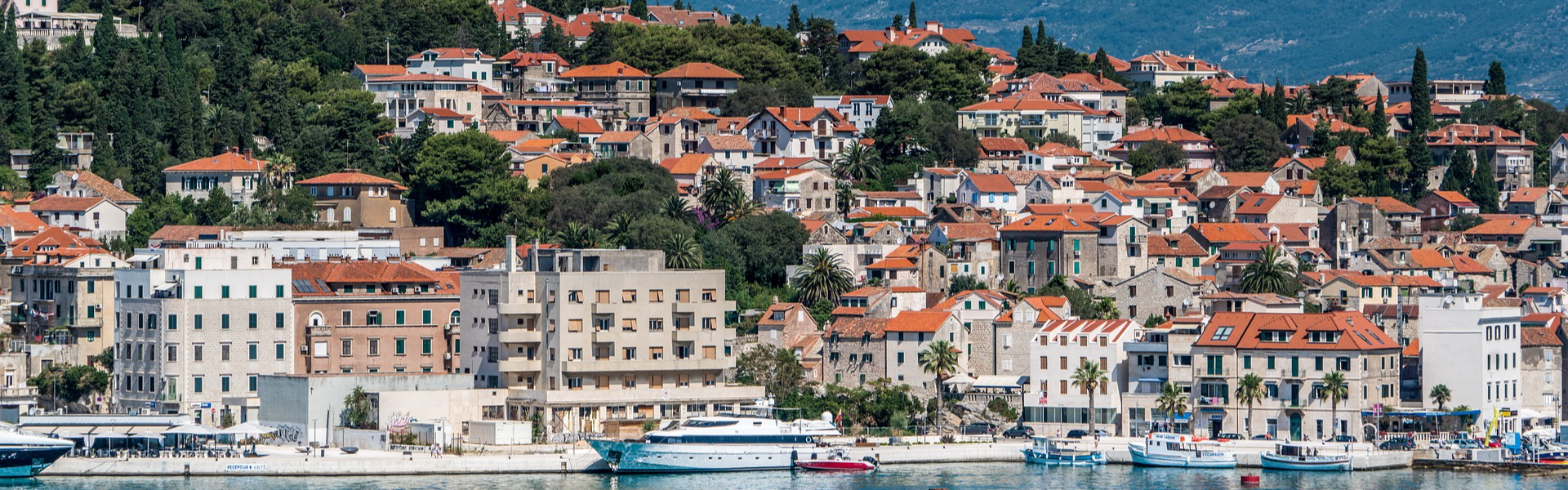
Split Travel from Canada: The Complete Guide
There are no non-stop flights from Canada to Split: from Montreal (YUL), plan on one European connection and 11 to 15 hours of total travel time, while from Toronto (YYZ) you can fly non-stop to Zagreb with Air Transat and connect on a short domestic flight. Canadian citizens do not need a visa for tourist stays of up to 90 days within any 180-day period in the Schengen area. The best times to visit are May-June and September, when the sea is pleasant and the crowds are manageable. Budget roughly $90 to over $370 CAD per person per day, excluding flights, depending on your travel style. The currency is the euro, and Split's UNESCO-listed old town sits literally inside Diocletian's Palace. The city is also the main gateway to the Dalmatian islands and a natural starting point for the rest of Croatia.
The essentials at a glance
| Key fact |
What to know |
| Flight from Montreal/Toronto |
No non-stop to Split; 1 stop via a European hub, 11-15 h total. From Toronto: non-stop to Zagreb (about 8 h 45 min), then a roughly 45-minute domestic flight |
| Visa/entry requirements |
No visa for Canadians (maximum 90 days in any 180-day period in the Schengen area); biometric EES registration on arrival |
| Time difference |
6 hours ahead of Montreal and Toronto in summer (noon in Montreal = 6 p.m. in Split) |
| Currency |
Euro (EUR); 1 € ≈ $1.62 CAD as a guideline (July 2026) |
| Language |
Croatian; English is generally well understood in tourist areas |
| Best time to go |
May-June and September |
| Driving |
On the right, as in Canada |
| Electricity |
230 V, European type C/F plugs: adapter required |
Why Split
Split is unlike any other city on the Adriatic: its old town is not built around a Roman monument, it is built inside one. Diocletian's Palace, a UNESCO World Heritage Site, still serves as the city's street grid. You wander freely between the Peristyle, the Cathedral of Saint Domnius and lanes that are still lived in today.
Split's other great asset is its harbour, right at the foot of the old town. Jadrolinija and Krilo ferries and catamarans leave for Hvar (about 1 hour), Brač and Vis: you can have lunch on the Riva promenade and swim off an island the same afternoon. The city also makes a practical base for day trips to Trogir or Krka National Park.
In July and August, Split is buzzing with festivals, nightlife and well-filled island ferries. Even then, it stays less overwhelmed than Dubrovnik at peak season, and day-to-day costs are generally a little gentler. For a first trip to Dalmatia, Split is often the best home base.
When to go
| Period |
Climate and atmosphere |
Notes |
| May-June |
Pleasant sea, lively terraces, manageable crowds |
One of the two best windows of the year |
| July-August |
Very lively: festivals, nightlife, packed island ferries |
Peak season, yet less saturated than Dubrovnik |
| September |
Sea still pleasant, crowds thinning out |
Excellent compromise for sightseeing and swimming |
| October to April |
Quiet season, a more local feel |
Reduced sea connections: Split-Dubrovnik catamarans run from April to October |
If swimming and island-hopping without the crush are your priority, aim for May-June or September. If you want the festival and nightlife atmosphere, July-August works well, provided you book accommodation and ferry crossings well in advance.
Getting there from Canada
There is no non-stop flight between Canada and Split. From Montreal (YUL), you reach Split Airport (SPU, in Kaštela) with one connection through a major European hub such as Frankfurt, Munich, Zurich, Vienna, Paris or Rome; total travel time typically runs from 11 to 15 hours. The airport is about 25 km from the city centre, linked by the Pleso shuttle, bus 37 or taxi.
From Toronto (YYZ), a popular alternative is Air Transat's non-stop flight to Zagreb (about 8 h 45 min), followed by a domestic flight to Split of roughly 45 minutes, or an intercity bus or train. And if your itinerary starts in Dubrovnik, seasonal fast catamarans run up the coast to Split (see below), a scenic way to link the two cities without another flight.
Split's highlights, in town and nearby
Diocletian's Palace and the old town
In Split, the old town IS the Roman palace. You enter the ancient walls as you would any neighbourhood, free of charge, and find the Peristyle (the colonnaded central square), the Cathedral of Saint Domnius and a maze of lanes where people live, work and hang laundry between 4th-century stones. Buy tickets for the remarkably preserved palace cellars, as well as for the cathedral and the climb up the bell tower. At the foot of the walls, the Riva promenade runs along the waterfront: it is where locals gather for morning coffee and evening drinks alike.
Marjan hill and Bačvice beach
West of the old town, Marjan hill is Split's green lung: walking and running trails, viewpoints over the city and the open sea, and small beaches at the foot of its slopes. It is the place to catch your breath between sightseeing days. On the other side of the centre, the Bačvice district has the city's best-known urban beach, a short walk from the old town. Its shallow water makes it a family-friendly swimming spot, very busy in summer.
Islands from Split: Hvar, Brač and Vis
Split's harbour, right below the old town, is the gateway to the Dalmatian islands. Jadrolinija and Krilo ferries and catamarans serve Hvar in about 1 hour. Brač is best known for Zlatni Rat, the pebble spit near Bol whose tip shifts shape with the currents, one of Croatia's most photographed beaches. Vis, more remote, has kept a quieter character; the Blue Cave on the islet of Biševo, known for the blue light that fills it in late morning, is generally reached from Vis or on organized day trips from Split. In July and August, buy your crossing tickets in advance: the most popular departures sell out.
Trogir and Krka National Park
A short hop west of Split, the small town of Trogir is an easy half-day visit: its medieval historic centre, set on an islet between the mainland and the island of Čiovo, is entirely walkable. The other classic day trip from Split is Krka National Park, renowned for its waterfalls and cascading pools in a green gorge; day tours generally run from Split, either guided or self-drive. In peak season, start early: the boardwalk trails are narrow and crowds build quickly by midday.
The sea route to Dubrovnik
From April to October, fast catamarans link Split and Dubrovnik daily: expect 4 h 30 min to 6 h depending on stops, from roughly 40 to 50 € per person, with Kapetan Luka-Krilo, TP Line and Jadrolinija. Boats arrive at Gruž harbour, a short ride from Dubrovnik's old town. It is the most enjoyable way to combine the two cities in a single trip, with the Dalmatian coast as a backdrop for the whole crossing.
The budget, in Canadian dollars
| Category |
Per day, per person (excluding flights) |
What it covers |
| Budget |
$90-$140 CAD |
Hostel or simple room, konobas (local taverns), public transit and basic ferry crossings |
| Mid-range |
$180-$290 CAD |
3-4 star hotel, restaurants, attraction tickets, a few excursions |
| Comfort |
$370 CAD and up |
Well-located upper-tier hotel, private excursions, fine dining |
These amounts are cautious estimates, provided as guidelines only, established in July 2026. Split generally runs a little cheaper than Dubrovnik, especially for peak-season accommodation. Add the Croatian tourist tax, collected directly by your accommodation, in the range of 1 to 2.65 € per person per night depending on the season. Quick conversion benchmark: 100 € ≈ $162 CAD. Ferry and attraction prices can change: confirm them when you book.
Entry requirements and health for Canadian citizens
-
Passport: valid for at least 3 months after your planned departure from the Schengen area; in practice, 6 months of validity is recommended.
-
Visa: none required for tourist stays, up to 90 days in any 180-day period across the whole Schengen area (Croatia and other Schengen countries count together).
-
EES: since the European Entry/Exit System came into force, your facial image and fingerprints are recorded at your first border crossing. No advance steps are needed: simply allow a few extra minutes on arrival.
-
ETIAS: not yet in force as of July 2026 (launch planned for the last quarter of 2026; applications are not open). In practical terms, there is nothing to do for a trip this summer; beware of unofficial websites already claiming to sell this authorization.
-
Health: keep routine vaccines up to date; hepatitis A is recommended for Croatia, and tick-borne encephalitis is present in some regions from April to November. Visit a travel health clinic 4 to 6 weeks before departure.
-
Travel insurance: essential, with coverage for medical care abroad.
-
Official advice: check travel.gc.ca before you leave. As of July 2026, the Government of Canada advises Canadians to “take normal security precautions” in Croatia.
-
Cash: mandatory customs declaration if you carry 10,000 € or more when entering or leaving the European Union.
One last tip: build your stay around the ferry schedules. Three nights in Split cover the old town, Marjan and one island; a week lets you add Trogir, Krka and a second island, or finish in Dubrovnik by catamaran. Book July-August accommodation several months ahead.
Ready to see Dalmatia from the deck of a catamaran? An AquaTerra advisor will plan your flights, island crossings and every night of your stay with you, at your budget. 450-628-6241 | 1-866-628-6241 | info@voyagesaquaterra.com
Voyages AquaTerra holds a Québec travel agency permit.