Departure

Return


Loading

Dubrovnik Travel from Canada: The Complete Guide

Canadian citizens do not need a visa to visit Dubrovnik: Croatia is part of the Schengen area, which allows tourist stays of up to 90 days within any 180-day period. There are no direct flights between Canada and Dubrovnik; from Montreal (YUL), plan on 11 to 15 hours total with one connection through a major European hub such as Frankfurt, Munich, Zurich, Vienna, Paris or Rome, while from Toronto (YYZ) you can fly Air Transat non-stop to Zagreb and connect to a short domestic flight. The best times to visit are May-June and September to early October, when the sea is warm and crowds are manageable; July and August bring extreme congestion to the old town. Croatia has used the euro since January 1, 2023; as a guideline, 1 € was worth about $1.62 CAD in July 2026. Excluding flights, budget roughly $100 to $160 CAD per person per day on a tight budget, $200 to $330 CAD mid-range, and $420 CAD and up for comfort; Dubrovnik is Croatia's most expensive city in summer.

The essentials at a glance

Item What to know
Flights from Montreal/Toronto No direct flights to Dubrovnik; 11 to 15 h via a European hub from YUL, or Air Transat non-stop YYZ-Zagreb (about 8 h 45 min) plus a 1 h domestic flight
Visa / entry No visa (maximum 90 days in any 180-day Schengen period); EES biometric registration on arrival
Time difference 6 hours ahead of Montreal and Toronto in summer (noon in Montreal = 6 p.m. in Dubrovnik)
Currency Euro (€); 1 € ≈ $1.62 CAD as a guideline (July 2026)
Language Croatian
Best time to go May-June and September to early October
Driving On the right, as in Canada
Electricity 230 V, European two-round-pin plugs (types C and F): adapter required

Why Dubrovnik

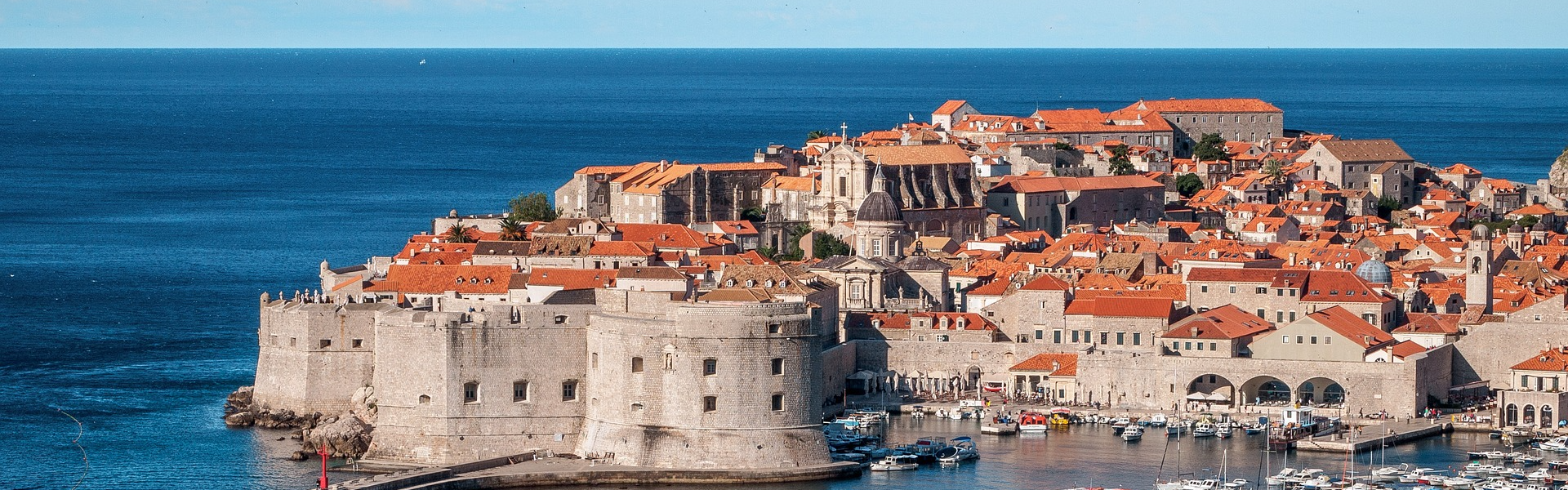
Dubrovnik's old town is fully pedestrian and completely enclosed by its walls, right on the Adriatic. You enter along the Stradun, the polished stone main street, and everything is on foot: forts, museums, stepped alleys, terraces wedged between stone walls. Few cities anywhere offer such a complete, concentrated fortified ensemble. It is the southern gateway to Croatia, and often the first image travellers associate with the country.

The city is much more than its walls. The port of Gruž handles the ferries and hosts the market; the Lapad and Babin Kuk districts hold the beaches and resort-style hotels; Lokrum island sits 15 minutes by boat from the old harbour; and the Mount Srđ cable car lifts you above the rooftops for the big view. In a few days you move easily between stone, sea and islands.

Let's be honest: Dubrovnik is a victim of its own success. In July and August the old town gets extremely crowded, with cruise ship arrivals amplifying the flow, even though the city limits simultaneous disembarkations. The good news is that with a smart schedule, meaning early mornings, evenings after 5 p.m. and island days when ships are in, the city is genuinely enjoyable. Our concrete tips are below.

When to go

Season Climate and atmosphere Note
May-June Sea warming up, lively terraces, crowds still reasonable One of the two best windows of the year
July-August Intense heat, extreme crowds in the old town and on the walls at midday Book early; visit before 9 a.m. or after 5 p.m.
September to early October Warm sea, thinner crowds The best trade-off along with May-June
November to April Low season, generally quiet Split-Dubrovnik catamarans only run April to October

If your dates are flexible, aim for May-June or September: you get warm-water swimming without peak-summer congestion. If you travel in July or August, build your days around the quiet hours and save the islands for the busiest days.

Getting there from Canada

No non-stop flight links Canada to Dubrovnik. From Montreal (YUL), the typical routing runs through a major European hub (Frankfurt, Munich, Zurich, Vienna, Paris or Rome) with one connection, for a total of 11 to 15 hours depending on the layover. From Toronto (YYZ), Air Transat operates a non-stop flight to Zagreb (TS212, about 8 h 45 min, twice weekly), followed by a Croatia Airlines domestic flight of about 1 hour to Dubrovnik.

Dubrovnik-Čilipi Airport (DBV) is about 20 km from the old town, with shuttle service (Platanus or Atlas) and taxis for the transfer. By sea, seasonal fast catamarans link Split to Dubrovnik daily from April to October, taking 4 h 30 min to 6 h, from roughly 40-50 € ($65 to $81 CAD) per person, arriving at the port of Gruž. It is the simplest way to combine both cities in one itinerary without a car.

Dubrovnik's must-sees

The old town and the city walls

Walking the full circuit of the walls is Dubrovnik's number one experience: you follow the top of the fortifications with the sea on one side and the tiled rooftops on the other. In 2026 the adult ticket costs 40 € (about $65 CAD). For the same price, the Dubrovnik Pass includes the walls, about ten museums, Fort Lovrijenac and the city buses: the math is simple, get the Pass. The heat on the walls is intense at midday in summer; go early in the morning or after 5 p.m., when the light is also better for photos.

Lokrum and the Elaphiti Islands

Lokrum is the easiest escape: 15 minutes by boat from the old harbour, and you trade the Stradun crowds for a green island facing the walls. The Elaphiti Islands, northwest of the city, make an easy full-day boat excursion: a slow island pace barely an hour from the old town bustle. These outings are your best allies on high-traffic days.

Mount Srđ

The Mount Srđ cable car climbs above the city and delivers the big picture: the walled old town below, Lokrum straight ahead and the Adriatic stretching to the horizon. It is the best viewpoint for understanding Dubrovnik's geography before you walk its lanes, and a fine end-of-day outing as the sun drops over the sea.

Beaches and swimming

For swimming, the Lapad and Babin Kuk districts hold the beaches and resort-style hotels, a few minutes by bus from the old town (city buses are included in the Dubrovnik Pass). The sea is warm from late spring to early fall: May-June and September offer the best balance of water temperature and calm. Staying in Lapad is a sound strategy: you sleep near the beaches and pop into the old town whenever it suits you.

Day trip to Kotor (Montenegro)

From Dubrovnik, the Bay of Kotor in Montenegro works well as a day trip. Mind the paperwork: Montenegro is outside the Schengen area, so your passport is required and the EES entry/exit system applies when you re-enter Croatia; allow some extra time at the border. Your advisor can book the excursion with an early departure to maximize your time on site.

Dealing with cruise ship crowds

The city limits simultaneous ship disembarkations, but midday still gets dense in high season. Concrete habits that work: do the walls and the Stradun before 9 a.m. or after 5 p.m.; flip your schedule on peak days (Lokrum, the Elaphiti Islands or the Lapad beaches by day, the old town in the evening once the ships have sailed); and if you stay inside the walls, enjoy the first hours of the morning, when the city still belongs to its residents. Outside July-August, the pressure drops sharply.

The budget, in Canadian dollars

Travel style Per day, per person (excluding flights) What it covers
Budget $100 to $160 CAD Simple lodging, counter meals and markets, city buses
Mid-range $200 to $330 CAD Mid-range hotel, restaurants, city walls and boat excursions
Comfort $420 CAD and up Resort-style or old-town hotel, top tables, private outings

These are cautious estimates, as a guideline only: Dubrovnik is Croatia's most expensive city in summer. Add the Croatian tourist tax, collected by your accommodation (about 2.65 € per person per night in high season in Dubrovnik, roughly $4.30 CAD), plus the walls ticket or Dubrovnik Pass (40 €, about $65 CAD). Quick conversion benchmark on the ground: 100 € ≈ $162 CAD.

Entry requirements and health for Canadian citizens

  • Passport: valid for at least 3 months beyond your planned departure from the Schengen area; in practice, aim for 6 months of validity.
  • Visa: none required for tourist stays; maximum 90 days in any 180-day period, counted across the entire Schengen area.
  • EES: in effect; at your first Schengen border crossing, your facial image and fingerprints are registered. Nothing to do in advance, just allow a few extra minutes.
  • ETIAS: not yet in effect as of July 2026 (launch planned for the last quarter of 2026, applications not open). Nothing to do for now; beware of unofficial websites already selling fake authorizations.
  • Health: routine vaccines up to date; hepatitis A recommended; hepatitis B and rabies to consider depending on your activities; tick-borne encephalitis is present in some regions from April to November. See a travel health clinic 4 to 6 weeks before departure.
  • Travel insurance: essential, with coverage for medical care abroad.
  • Cash: customs declaration required if carrying 10,000 € or more when entering or leaving the European Union.
  • Official advice: Croatia is rated "Take normal security precautions"; check travel.gc.ca before you leave.

One last tip: do not squeeze Dubrovnik into a single day. Two or three nights let you do the walls early, an island by day and the old town in the evening, at the pace where the city shows its best side.

Want to combine Dubrovnik, the islands and the Dalmatian coast without the logistics headache? A Voyages AquaTerra advisor builds your itinerary (flights, hotels, catamarans, excursions) and steers you around the high-season pitfalls. 450-628-6241 | 1-866-628-6241 | info@voyagesaquaterra.com

Voyages AquaTerra holds a Québec travel agency permit.

Frequently Asked Questions

No. Croatia is part of the Schengen area, and Canadian citizens can stay visa-free for up to 90 days within any 180-day period. Your passport must be valid for at least 3 months beyond your planned departure from Schengen. On arrival, the EES system registers your facial image and fingerprints; ETIAS is not yet in effect as of July 2026.
There are no direct flights from Canada to Dubrovnik. From Montreal, plan on 11 to 15 hours total with one connection through a European hub such as Frankfurt, Munich, Zurich, Vienna, Paris or Rome. From Toronto, Air Transat flies non-stop to Zagreb (about 8 h 45 min, twice weekly), followed by a Croatia Airlines domestic flight of about 1 hour to Dubrovnik.
May-June and September to early October offer the best trade-off: the sea is warm and crowds are thinner. In July and August, the old town gets extremely crowded and the heat on the city walls is intense at midday; if you go then, plan your visits before 9 a.m. or after 5 p.m.
Yes. The Government of Canada rates Croatia at "Take normal security precautions," its lowest advisory level. As in any heavily touristed area, keep an eye on your belongings in crowds and check travel.gc.ca for up-to-date advice before departure.
As a guideline, excluding flights: $100 to $160 CAD per person per day on a tight budget, $200 to $330 CAD mid-range, and $420 CAD and up for comfort. Dubrovnik is Croatia's most expensive city in summer. Add the tourist tax (about 2.65 € per person per night in high season) and the city walls ticket or Dubrovnik Pass (40 €).
In summer, Dubrovnik is 6 hours ahead of Montreal and Toronto: when it is noon in Montreal, it is 6 p.m. in Dubrovnik. On your first day, a short nap and an evening on local time help absorb the jet lag.
In 2026, the adult ticket for the city walls costs 40 €, about $65 CAD. The Dubrovnik Pass sells for the same price and adds about ten museums, Fort Lovrijenac and the city buses, so it is almost always better value than the walls ticket alone.
Seasonal fast catamarans (Kapetan Luka-Krilo, TP Line, Jadrolinija) run daily between Split and Dubrovnik from April to October, taking 4 h 30 min to 6 h depending on stops, from about 40-50 € per person. They arrive at the port of Gruž, a few minutes by bus from the old town.
Visit the old town and the walls before 9 a.m. or after 5 p.m., once most cruise passengers have left. On peak days, flip your schedule: Lokrum (15 minutes by boat), the Elaphiti Islands or the Lapad beaches by day, then the old town in the evening. The city limits simultaneous disembarkations, but midday remains dense in July-August; outside those two months, the pressure drops sharply.
The euro: Croatia adopted it on January 1, 2023. As a guideline, 1 € was worth about $1.62 CAD in July 2026, so 100 € ≈ $162 CAD. Cards are widely accepted; a customs declaration is required if you carry 10,000 € or more in cash when entering or leaving the European Union.
  • #Sightseeing
  • #travel
  • #tourism
  • #beaches
  • #old town
  • #city walls
  • #culture
  • #history
  • #architecture
  • #restaurants
  • #Dubrovnik Game of Thrones
  • #Adriatic Sea
  • #Elaphite Islands
  • #excursions
  • #cruises
  • #hiking
  • #kayaking
  • #Dubrovnik Split
  • #Dubrovnik Montenegro
  • #Dubrovnik Mostar
  • #Dubrovnik Cavtat
  • #Dubrovnik Lokrum
  • #Dubrovnik Mljet
  • #Dubrovnik Korčula
  • #Dubrovnik islands
  • #Dubrovnik Croatia
  • #Dubrovnik climate
  • #Dubrovnik airport
  • #Dubrovnik beach
  • #Dubrovnik hotels.